

The lines on your list marked “nobody yet” are the job. Add up their hours and the list tells you when to hire, and what the new person does on day one.
This is the eighth post in the Load Audit series. The first made the case that when a small business stalls, the narrowest point is usually your week. The second got an honest list of where that week goes. The third sorted every line into stop, move, or keep. The fourth put the moves in order. The fifth set the test for when a handoff is actually done. The sixth showed how to hand something off so it stays gone. The seventh made sure the hours you free up go somewhere you chose.
That last post ended on a promise: the lines on your list marked “nobody yet,” and how adding up those hours tells you when it’s time to hire.
This is that post.
The Pile You Set Aside
Back in the third post, every line that needed to happen got one more question: who else could do this, if they were trained and you trusted them?
Most lines got a name. Your foreman. Your office manager. A piece of software.
Some didn’t. The honest answer was “nobody yet.” Not because the work needs you, but because there’s no one on the team to give it to.
In the fourth post, you pulled those lines out of the queue and set them at the bottom, in their own section. Visible, but not being worked.
That pile is what this post is about. It’s the most useful thing the whole audit produces when it comes to hiring, and most owners never build it.
Add It Up
Take every “nobody yet” line and add up the hours a week next to each one.
Here’s what that might look like for a builder:
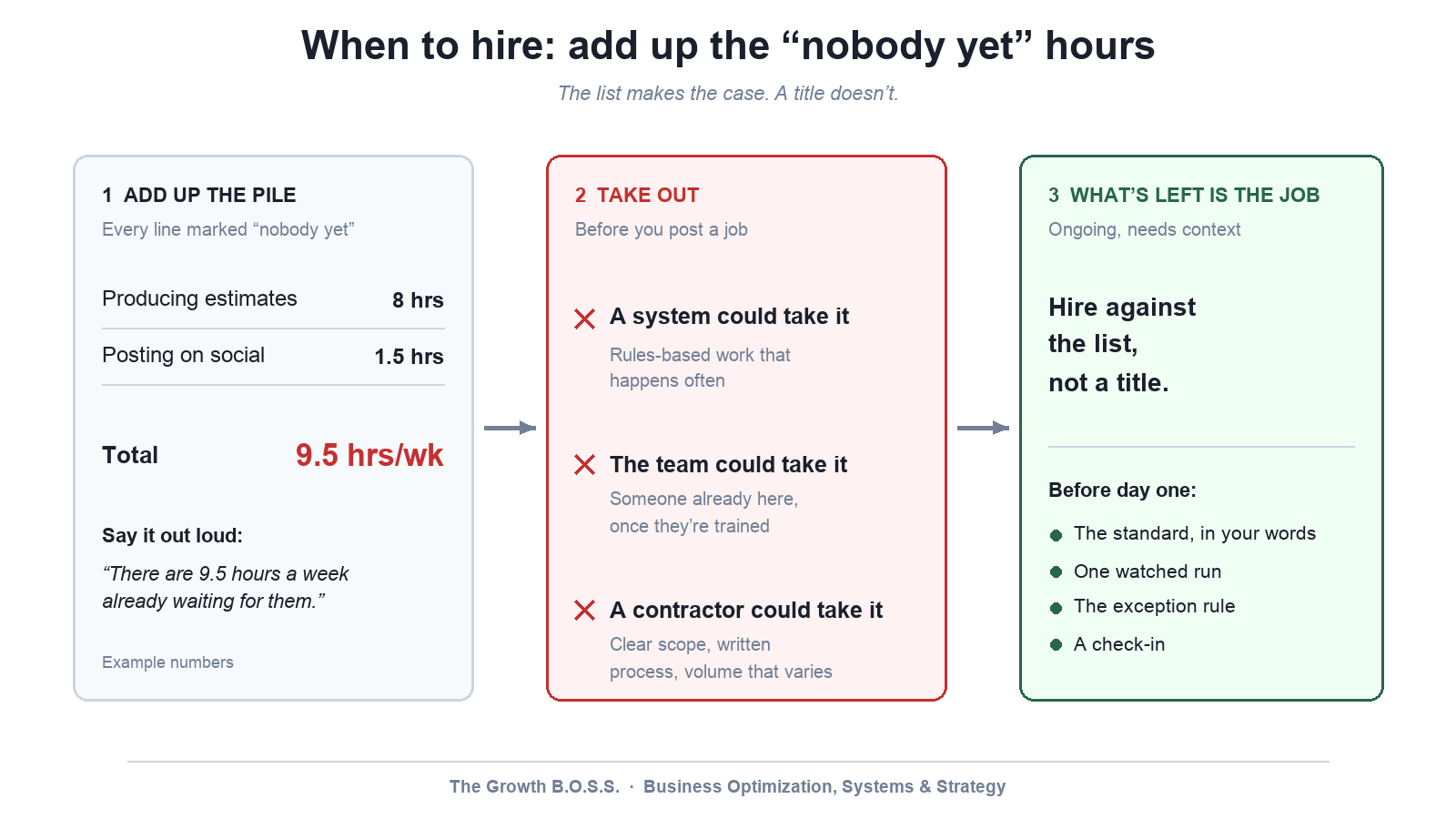
Producing estimates: 8 hours a week
Posting on social: 1.5 hours a week
That’s 9.5 hours a week, waiting for a person who doesn’t exist yet. Eight of it is one line.
Now say the total out loud. Something changes when you do.
Before the audit, the hiring conversation sounds like “I think I need someone.” After it, it sounds like “There are 9.5 hours a week already waiting for them.”
The first is a feeling. The second is a job.
And nobody told you to hire. The number came from your own list, one line at a time. That’s what makes it your decision instead of someone else’s opinion.
A Title Isn’t a Job
Most owners start a hire from the other end. They pick a title. An office manager. A project manager. A VA. Then they try to work out what that person should do.
A landscaping owner I worked with had done exactly that, more than once. “I’ve got like three page documents of what a project manager does, what a salesperson does…” he told me. “And then the year starts and it gets busier than we were. And then it’s like none of that stuff even happened.”
That isn’t a discipline problem. A job description written from a title describes a job that doesn’t exist yet. When the season hits, the new person ends up doing whatever lands in front of them, and you end up doing everything else.
Dan Sullivan and Benjamin Hardy make the case in Who Not How that the first question isn’t how to get something done, but who. The Load Audit adds one thing to that: you don’t get to name a who until you can point at the what.
“We need an office manager” is a wish. “We need someone to own these two recurring jobs, totaling 9.5 hours a week” is a role you can hire for, and a role you can check the new person against.
That’s also why the audit runs before any hiring conversation, never after one. Hire first, and the new person lands on whatever you happen to hand them. Run the audit first, and you know exactly which hours they’re walking into.
Check Three Things Before You Post a Job
The total tells you there’s work waiting. It doesn’t tell you the answer is a new employee. Before you write a job post, run the pile past three checks.
1. Could a system take it? Some of what looks like a hiring need is a process nobody has automated yet. Rules-based, high-frequency work, like screening calls, sending reminders, or chasing a signature, is usually cheaper to hand to software than to a person. Pull those lines out first.
2. Could someone already on the payroll take it, once you’ve trained them? Look again at every “nobody yet.” Sometimes the honest answer was “nobody I trust with it yet.” That isn’t a hire. That’s a handoff with a training problem, and the fifth and sixth posts cover it.
3. Does it need an employee, or just a set amount of help? Work that’s ongoing, needs context, and depends on how your crew works is a job for an employee. Work with a clear scope, a written process, and volume that goes up and down can go to a contractor or an outside service. Capability you don’t want to build at all might be a partner’s.
Whatever survives all three is the real hiring case. It’s usually smaller than the first total, and it’s much easier to defend.
Write It Down Before They Start
Here’s the part that catches most owners.
The day a new person starts, every line in that pile moves from your plate to theirs. If none of it is written down, the only way to get it out of your head and into theirs is you, standing next to them, explaining. The hire you made to save time starts by costing you time.
The same landscaping owner put it plainly when we talked about bringing on an assistant: “If it was up to me, I’d have the VA in my truck with me every day for three months until they get trained and spun up.”
Three months of riding along is the training plan you get by default when nothing is written down. It’s also the reason so many first hires feel like they didn’t work.
With a fence staining owner I worked with, we made the opposite call. An assistant hire was on the plan for the spring. We put it on hold until the work that person would take over was written down and proven by the people already there. Hiring into a process nobody can run yet just moves the training load back onto you, which is the opposite of the point.
So before anyone starts, every line in the pile needs the same four things from the sixth post: the standard in your own words, one watched run, the exception rule, and a check-in. The pile is the new person’s first task list. Make sure it reads like one.
Two Objections
“I already know who I need.”
You might. But check whether what you know is a title or a list. The fence staining owner had his hiring order ready: “I’d hire the crew leader and the helpers and an office assistant to do the scheduling… someone to do the sales.” That’s a good instinct. It’s still a list of titles. Put hours next to each one and you’ll find out which hire buys back the most of your week, and which one you were going to make first only because it came to mind first.
“I can’t afford a hire right now.”
Then don’t make one. Nothing else on your list requires it. Stops need no one. Moves to a system need no one. Moves to people already on the payroll need no new payroll. The “nobody yet” pile is the only part of the list that points at a hire, and it points with a number attached. Watch that number. When it’s big and steady enough that the hours would pay for themselves going to the work only you can do, you’ll know, and you’ll know what the job is.
Start Here
Find your “nobody yet” lines. If you’ve been following the series, they’re at the bottom of your list.
Add up the hours. Write the total at the top of the pile and say it out loud.
Cross out anything a system could take, and anything someone already on the team could take once trained.
Circle the biggest line that’s left.
That circled line is your next hire’s first job. Before you post anything, write down how it’s done.
If you’d rather have someone else look at your list with you, that’s what the Half-Day Walkthrough is: one afternoon inside your operation, and three fixes you can make that week. See how it works.
Next up: the last post in the series. The list isn’t a one-time thing. Every quarter you run it again, and what changed tells you more than the list itself.