

“More leads. That’s all it comes down to. If I have more leads, I’m going to close more business.”
That’s a landscaping owner, about a year into working together. A fence staining owner said the same thing about HOA management offices. A custom home builder said it about the lead platform he hated and kept paying for anyway.
Three businesses. Three industries. One diagnosis.
And they might be right. Sometimes the front of the business really is the problem.
But “more leads” isn’t just a diagnosis. It’s a bet. It’s a bet that everything downstream can absorb the volume when it shows up. Most owners have never checked that bet, because the question “could we handle more?” gets answered by feel — and everyone feels capable of more.
This is about how to actually check it — real capacity planning, not a gut check — and what the check usually finds.
Every Business Is Five Boxes — Only One Is the Bottleneck
Work moves through a small business in five stages.
Attract — how leads and attention get generated.
Convert — how leads become paying customers.
Deliver — how the work actually gets done.
Collect — how and when the money arrives.
Retain & Grow — how customers come back, buy more, or send someone else.
Money enters on the left and exits on the right. And the business produces whatever the narrowest box lets through.
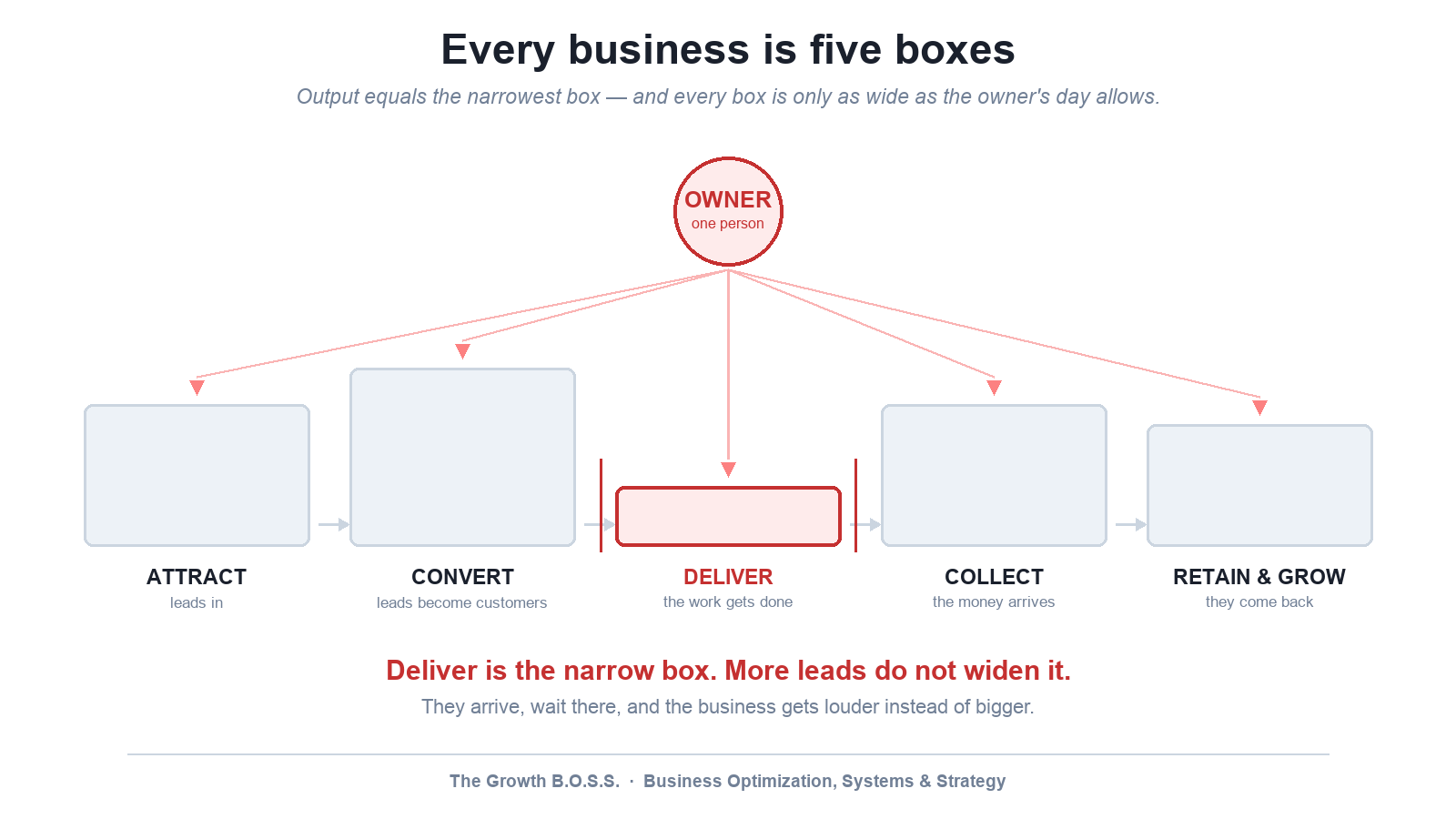
That’s Eliyahu Goldratt’s Theory of Constraints, stated for a company with a truck instead of a factory: every system has one point that sets the pace for the whole, and improving anything else doesn’t increase output.
Which means “more leads” is a bet that Attract is the narrow box.
If it isn’t, more leads produce more quotes sitting unanswered, more jobs pushed back, more customers waiting on a callback. The volume arrives and the business doesn’t grow. It just gets louder.
The Question You Can’t Answer By Feel

So which box is narrowest?
You can’t answer that from the inside. Not because you aren’t sharp — because you’re the one absorbing every gap personally, and absorbed gaps are invisible.
When the schedule slips, you work Saturday. When the customer is unhappy, you drive out. When the estimate has to go tonight, you write it at ten.
From inside that, every box feels like it’s working. It is working. It’s working because one person is paying for it out of your own week.
The fix isn’t to think harder about it. It’s to score it, on questions specific enough that the answer stops being a feeling.
The Column That Answers “Do I Need More Leads?”

Score all five boxes, 1 to 5, on four columns. One of them answers the leads question directly.
Ease of scaling — could this box handle double the volume next month?
1. It would collapse. No path to doubling without breaking something.
2. Only by brute force — overtime, you working nights, quality slipping.
3. Doable, but needs people or spend not yet lined up. A quarter to be ready.
4. Mostly ready. One known addition — a person, a tool, a vendor — and it handles 2x.
5. Handles 2x as-is. The capacity is already there.
Read those and something happens that doesn’t happen when the question is just “could you handle more?”
Owners who would have said yes land on a 2 for at least one box. And they land there without argument, because they recognize the description. Overtime. Nights. Quality slipping. That’s not a prediction about the future. It’s what happened the last time things got busy.
A 2 in Deliver means the leads you’re about to buy will be delivered on overtime at declining quality.
That’s not growth. That’s borrowing from next quarter.
The other three columns are flow consistency (does work move through at a predictable rate?), backlog (is work waiting here?), and owner-time dependency (how much does this box need you personally?). Same 1 to 5. Same style of anchor — written to be observable rather than felt, so the number you’d defend and the number someone watching your business would give it can be put side by side and argued about.
Two rules make the scoring work.
No half points. Forcing a 3-or-4 choice is where the real thinking happens. Half points are how you avoid committing.
The 3s are the diagnostic. A 1 is obvious to everyone, including you. It’s rarely news. The gap between a 3 you’d give and a 2 someone else would give is where you find what you’ve normalized.
What the Grid Shows About Owner Dependency That No Single Box Does

Score all five boxes on all four columns and you get a grid.
Most of the time the lowest total points at a box, and that box is the constraint. Work there.
But in owner-run businesses there’s a second pattern, and it’s the more common one.
Owner-time dependency scores lowest across three or more boxes.
Not one box that’s weak. One person every box depends on. Quoting routes through you. Nobody else can close. You’re the only one with the passwords. Every decision waits.
When that’s the shape, the constraint isn’t a box at all. It’s a resource all five boxes draw on. The five boxes model the flow of value — they have no box for the owner, because in the businesses that model was built for, the owner isn’t standing in the flow. In a business your size, you’re standing in all of it.
And this pattern is only visible in the grid.
Look at any single box and your involvement reads as normal. Of course you’re involved in Convert — you’re the best closer in the company. Look across all five and you see one column low in every one of them, and the picture changes.
You aren’t heavily involved in Convert. You’re the constraint, and Convert is one of five places it shows up.
Two Objections, Both Fair

“I know my numbers.”
Most owners do — the job ones. That fence staining owner could price by linear foot in his head and was rarely wrong. Six years in, he’d never looked at a P&L until year end. When he finally did, he found he’d been counting his own salary as profit.
Knowing the unit economics of the work is not the same as knowing the capacity of the business. One gets measured every day. The other has never been measured at all.
The close rate version is sharper. One owner told the team they closed 85% of their quotes. Three weeks later, asked where that number came from: “I pulled ninety percent out of my ass. I don’t know what my close rate is.”
Both statements were honest. Neither one was measured.
“I’m the most efficient person here. That’s why it routes to me.”
Usually true. “Seriously, guys, how did it take you that long? I could have done it myself in two and a half hours.”
He could have. But a business where the owner is the fastest at the work has a ceiling exactly the height of one person’s week. And every hour spent being the fastest is an hour that ceiling doesn’t move.
Being right about your own efficiency is how the constraint stays in place.
The Order This Puts Things In: Exploit Before You Elevate

If the grid says you’re the constraint, the sequence is fixed — and it’s the opposite of the instinct.
Goldratt’s second step is to exploit the constraint before you elevate it. Get everything you can out of the limited resource before you spend money expanding it.
That means: before you buy leads, before you hire, before you add a service line, find out where your hours actually go and get the non-essential load off.
Skip that step and the hire lands on the work you like least instead of the work that’s limiting the business. Six months later you’re still the constraint, with payroll on top.
Here’s what it looks like when the order is followed.
That fence staining owner’s plan in January was to hire a virtual assistant in March. A month later, with a clearer picture of where his week actually went, the VA was canceled. The scheduling and material ordering he’d planned to hand off weren’t the load. The estimating was — and estimating needed a trained estimator, not a VA.
Same money. Different hire. Because the picture came first.
One more thing about that grid. If owner-time dependency is your low column, score the other three columns a second time — this time as if you weren’t in the business at all.
“I’m the bottleneck” on its own is true and useless. You already knew it, and it doesn’t tell you what to do Monday. The second read does: it tells you which box breaks first as you step out. That’s the one to work on, and it’s almost never the box you’d have guessed.
What Comes Next

If your time is the constraint, three things follow.
You need an honest inventory of where those hours go. Not a job description. Not a guess. And not a spreadsheet filled in on a Sunday — I’ve assigned that version and watched it go unfinished. There’s a way to get it in a single conversation.
You need a decision on every line. Does this need to happen at all, and can it leave — asked in an order that doesn’t accidentally strip out the work only you should be doing.
You need a test for whether the load actually left. A task handed off and quietly taken back three weeks later shows up as “delegated” on every list I’ve ever seen. The constraint hasn’t moved an inch.
That’s what a task audit is for. Not time management. Not productivity.
It’s how you find and relieve the constraint when the constraint is a person.
Start Here

Don’t score the whole grid yet. Take one column and five boxes, and give yourself five honest numbers.
Attract. Convert. Deliver. Collect. Retain & Grow.
If volume doubled next month, which of these collapses? Which survives on overtime and slipping quality? And which is genuinely ready?
No half points.
If any box is a 2, you’ve found something more valuable than a new lead source. You’ve found where the next thirty leads are going to land.