

Your first handoff is a test of whether delegation works in your business at all. Pick the one built to pass, and the order of everything after it takes care of itself.
This is the fourth post in the Load Audit series. The first made the case that when a small business stalls, the narrowest point is usually your week. The second got an honest list of where that week goes. The third ran two questions down that list and sorted every line into stop, move, or keep.
If you did that, you’re looking at a pile of moves. Real work, with a name next to it, that doesn’t need to be yours.
So which one goes first?
The Instinct: Start With the Biggest
Almost every owner points at the same line. The one with the most hours on it.
Usually it’s estimating. Or scheduling. Eight hours a week, sometimes more. Hand that off and you get a full day back. On paper, it’s the obvious call.
It’s also the handoff most likely to fail.
Not because the person receiving it isn’t capable. Because the biggest job on your plate is almost always one that hurts when it goes wrong. A bad estimate loses money. A blown schedule puts a crew on the wrong site. So you watch it closely, you catch the first mistake, you fix it yourself, and three weeks later it’s quietly back on your desk.
Your First Handoff Is a Test
Here’s what that failure actually costs.
It isn’t the hours. It’s the conclusion. When the first thing you hand off comes back, you don’t decide that task was a bad pick. You decide that delegation doesn’t work in your business. That your people aren’t ready. That it’s faster to do it yourself.
And that conclusion stalls everything else on the list.
So the first handoff isn’t really about hours. It’s a test, of the person receiving it and of the process. Which means the first one should be chosen to pass: safe if it goes wrong, obvious when it goes right, and fast enough that you feel the time back within a couple of weeks.
The Order, Step by Step
None of this takes judgment. Two people with the same list end up with the same order.
1. Set aside the “nobody yet” lines. Anything without a receiver moves to the bottom, in its own section. It stays visible. That’s your hiring case, and you’ll come back to it. It just isn’t in the queue yet.
2. Sort what’s left by what happens when it goes wrong. Last post, every line got a mark: it degrades if it doesn’t happen, it breaks, or the business can’t breathe without it. Hand off in that order. Work that degrades can be handed off imperfectly and nobody gets hurt. Work that breaks can’t. The work the business breathes through moves last, after the people taking it have a few wins behind them.
3. Inside each group, small work goes before big work. Not small in hours. Small in shape.
Some of your week is the recurring work that keeps the business running: estimating, scheduling, ordering materials, closing jobs. Call those pebbles. Some of it is everything around that work: the questions, the interruptions, the calls, the admin, the small fires. Call that sand.
Sand goes first. It usually leaves through a rule or an automation, not a new role. Nobody has to learn a trade to take it. And because it comes in a hundred small pieces a week, you feel it leave almost immediately.
4. Then biggest hours first. Only now does the size of the line matter.
Number the result top to bottom. That’s your queue.
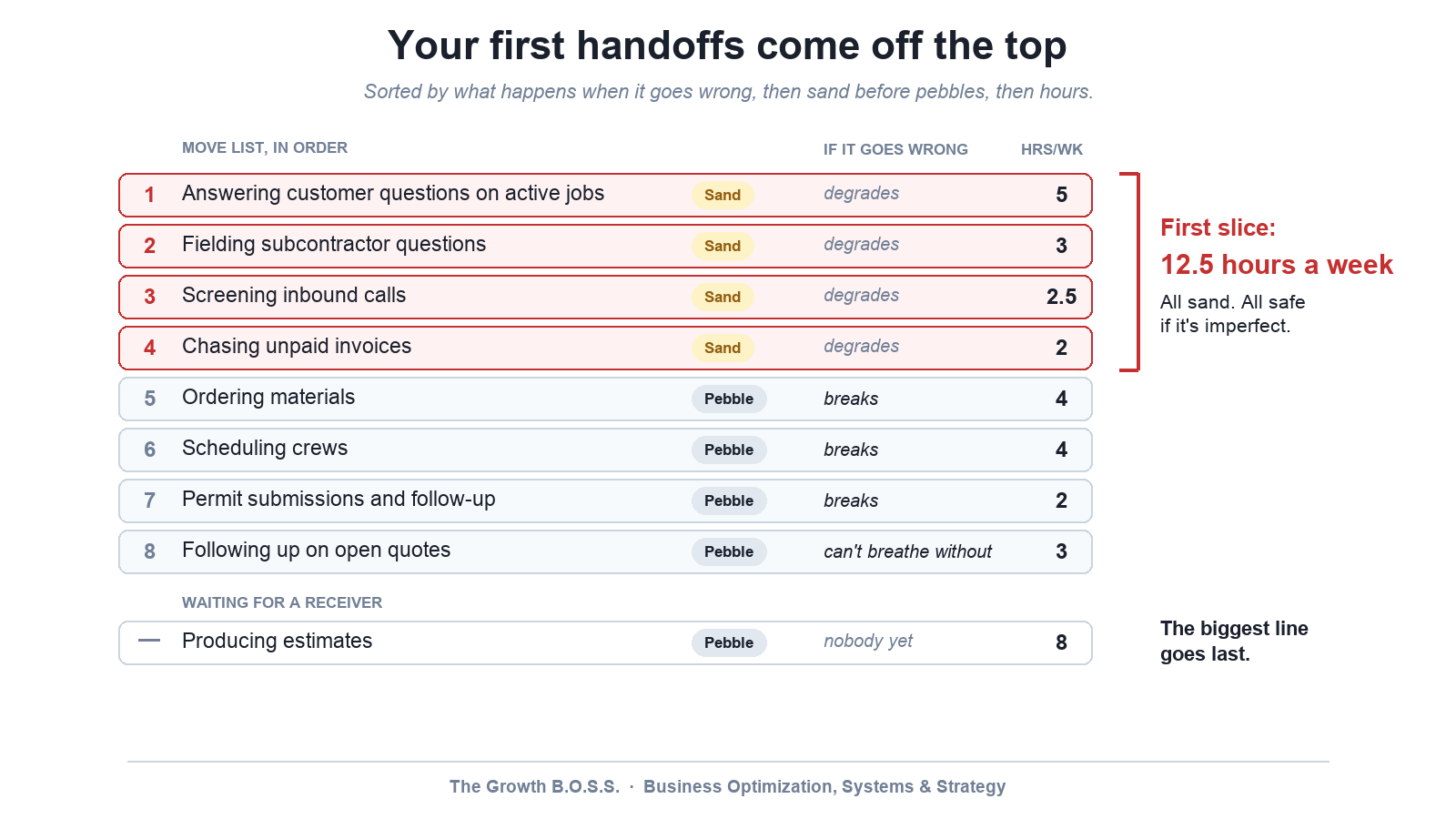
What That Looks Like
A custom home builder I work with was getting a steady stream of calls on his business line, a lot of them sales pitches and spam. Every one was an interruption. Every one pulled him out of whatever he was doing.
That’s sand. And it was the first thing to go, through a system rather than a person: an AI receptionist screens the line, and the calls that matter arrive as a short summary he handles when he chooses.
It wasn’t perfect out of the gate. The first version let some spam through and needed tuning. Which is exactly why it went first. When it got something wrong, nothing broke. A junk call got through. That was the worst case.
Compare that to a medical practice I work with that put the same kind of tool on its phones. After hours, it worked well: basic questions answered, nothing urgent at stake. During office hours, with real patients calling about real appointments, it performed poorly, and they pulled it back to after-hours only.
Same tool. Same practice. The difference was what happened when it got something wrong.
One Handoff Per Person at a Time
There’s one more rule, and it’s the one most delegation plans skip.
Count how many items on your first slice go to the same person. If your foreman has three, he gets the top one. The next one doesn’t start until the first is truly off your plate.
Stacking three new responsibilities on one person at once is how a good hire fails at all three. Nothing slides down the list to fill the gap, either. The second item waits, visible, marked as waiting on him.
The Whole List Stays Visible
You’re not picking a few tasks and forgetting the rest. You’re working a slice off the top of a list you can see all of.
How big the slice is depends on your business and your people. But it’s always the top of the list, in order, never a hand-picked set of the ones that feel most urgent this week. The ones further down aren’t forgotten. They’re next.
Two Objections
“But the big one is where the hours are.”
It is. And you’ll get to it, with a team that has already handed things off successfully, a process that’s been tested, and a lot more confidence that it’ll stick. The big one doesn’t get easier by going first. It gets easier by going later.
“The small stuff won’t move the needle.”
Add it up before you decide. Sand is the part of the week nobody counts, because no single piece of it feels like anything. Answering crew questions, screening calls, chasing a late invoice, fielding the same customer question for the fourth time. Four lines like that can easily add up to more hours than the big one, and every one of them leaves faster.
Start Here
Take your move list from the last post.
Cross out every line marked “nobody yet.” Then cross out anything marked breaks, and anything the business can’t breathe without.
Of what’s left, circle the line that’s interruptions, questions, or admin rather than a job with a name.
That’s your first handoff. Start it this week.
Next up: a handoff isn’t finished when you hand it off. It’s finished when it stays gone, and there’s a simple test for telling the difference.