

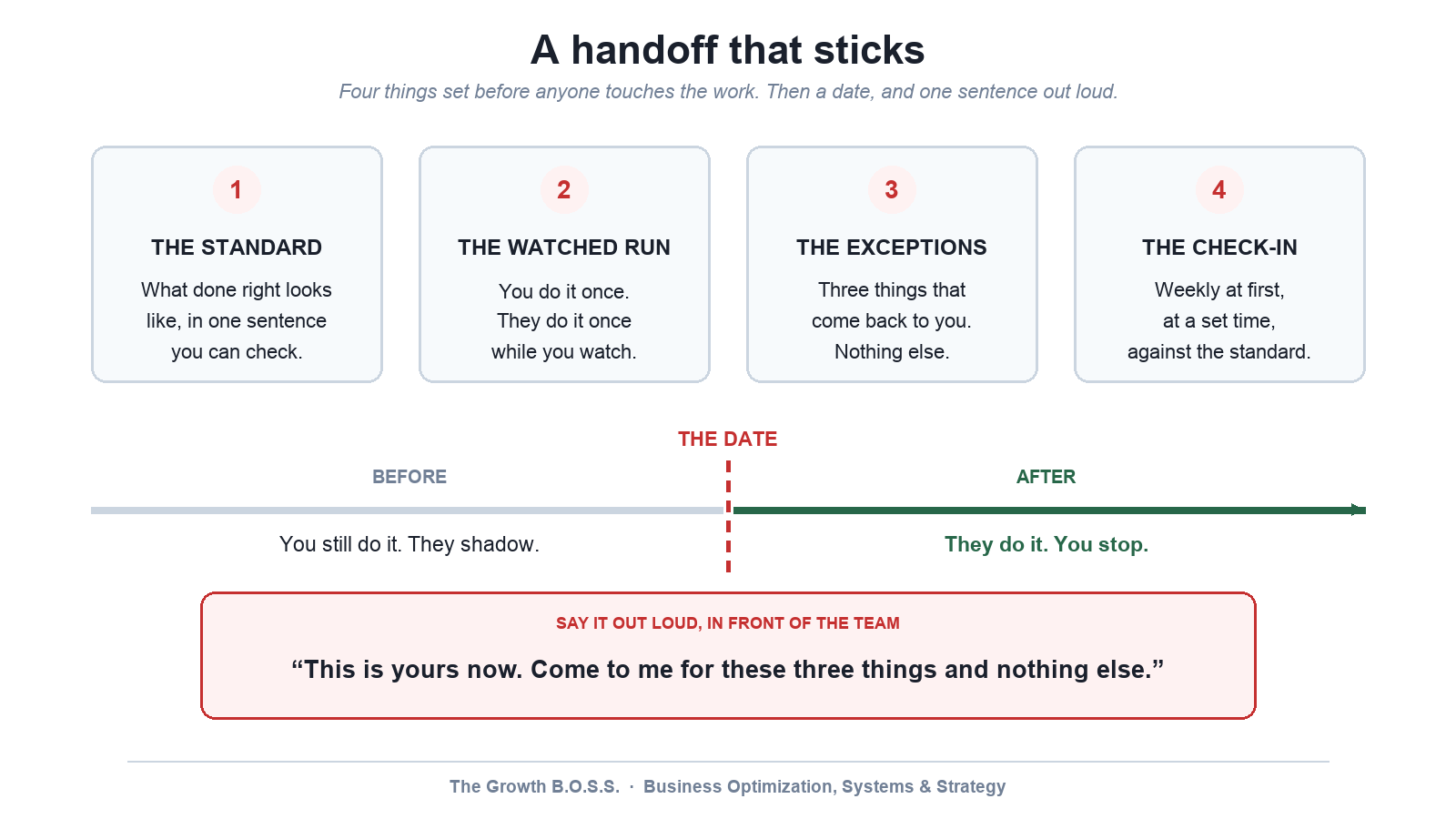
A handoff sticks when four things are set before anyone touches the work, and you tell your team out loud that it’s theirs now.
This is the sixth post in the Load Audit series. The first made the case that when a small business stalls, the narrowest point is usually your week. The second got an honest list of where that week goes. The third sorted every line into stop, move, or keep. The fourth put the moves in order and picked the first handoff. The fifth set the test for when a handoff is actually done: twice, unprompted, to your standard.
That last post ended on a promise: how to hand something off so it actually stays gone.
This is that post.
The Real Fear Behind Every Handoff
If you ask yourself why a job is still on your plate, the honest answer is usually some version of “they’d do it wrong.”
But that isn’t quite the fear. Everybody gets things wrong once, including you. The fear is that it’ll be done wrong and you won’t find out. Not until a customer calls. Not until it’s too late to fix quietly.
So you keep the last look. You check every quote before it goes out. You ask on Thursday whether it got done. And the job that was supposed to leave stays half yours.
A fence staining owner I worked with put it plainly. That season was the first time he’d let a crew go out on a job without him there, and it made him nervous. Nothing specific had gone wrong. It was the not knowing.
Even handing over the company gas card worried him. “These are things I’m nervous about, giving that kind of stuff away,” he told me. “But again, you have to.” And on his biggest quotes, he wanted to have the last eyes on every one before it went out.
That isn’t a character flaw. It’s a reasonable response to a handoff with no way to see inside it. The fix isn’t trusting harder. It’s building the handoff so that if something goes wrong, you’ll know, fast, and on purpose.
Four things do that. Set all four before the other person touches the work.
1. The Standard, in Your Own Words
Start with one question: what does this look like when it’s done right?
Answer it specifically enough that someone could check it. “Handle customer questions well” can’t be checked. “Same-day reply, and if we don’t know the answer yet, tell them when they’ll have it” can.
Write it down in your words, not in the language of a job description. This becomes the line the other person is measured against.
Here’s the hard part. Once you’ve set it, you don’t get to move it after the fact. If the work meets the standard and you still don’t like it, the standard was wrong. Fix the standard for next time. Don’t fix the work yourself, because that’s exactly how a job drifts back onto your plate.
2. One Watched Run
Before the handoff, do the job once while the other person watches. Then switch: they do it once while you watch.
Don’t skip this, even if you’ve written great instructions. Documents transfer information. Watching transfers confidence, and it goes both ways. They see what “done right” looks like in practice. You see them do it right with your own eyes. That second part matters more than most owners admit.
If you already have a written process, good. The watched run doesn’t replace it. It’s the proof that the process works in someone else’s hands.
3. The Exception Rule
Ask yourself: when does this come back to me?
Name the conditions. A dollar amount above which you want to see it. A type of customer. A specific situation. Those come to you. Everything else belongs to the other person. Full stop.
This is the piece that makes letting go feel safe. You’re not giving up control. You’re defining exactly where your control starts.
It also fixes one of the most common reasons a handoff bounces back: the other person doesn’t know what’s theirs, so they bring you everything. A clear exception rule tells them what not to bring.
Keep the list short. Three things is plenty. If the list of exceptions is longer than the job, you haven’t really handed it off.
4. A Weekly Check-In, at First
Decide who checks, how often, and where it’s visible. For your first few handoffs, the checker is you and the cadence is weekly.
Weekly can feel like a lot. It’s meant to. You haven’t seen this go right yet, so starting at monthly asks for trust you don’t have. Earn your way to less often by watching it work.
Check at a set time, against the standard you wrote. Not by hovering over every one. That’s the difference between checking a handoff and taking it back.
Then You Stop
Pick a date for the handoff. Until that date, you’re still doing the job and the other person is shadowing. On that date, it flips. They do it. You stop.
That sounds obvious. It’s the step that gets skipped most. The handoff “happens,” but you keep doing a piece of it in the background, just in case. And the other person, seeing you still doing it, reasonably assumes it’s still partly yours.
Say It Out Loud
One last thing, and it’s the one that makes the rest stick.
Tell the other person, in front of your team if you can: “This is yours now. Come to me for these three things and nothing else.”
A handoff you haven’t personally announced is a handoff your team treats as optional. If people still bring the work to you, and you still answer, nothing changed. Saying it out loud changes who they go to.
The same fence staining owner knew exactly what he wanted from a crew leader. It was worth paying well, he said, for someone “that you can be like, ‘All right, man, this is you.'”
That sentence is the handoff. Everything above it is what makes it safe to say.
Two Objections
“It’s faster to just do it myself.”
This week, it is. A written standard, a watched run, and a weekly check-in cost more time than doing the job once. But you’re not doing it once. You’re doing it every week, for as long as it stays yours. Doing it yourself is only faster than explaining if you never count the weeks after. The setup gets paid once.
“What if they get it wrong anyway?”
Sometimes they will. That’s what the weekly check-in is for. You’ll find out within days, not months, against a standard you both agreed on. A mistake you catch on Friday is a training moment. A mistake you find three months later is the reason you stop delegating. These four pieces don’t prevent every mistake. They make sure you hear about it.
Start Here
Take the handoff you picked after the fourth post, or anything that’s in transit right now.
Before it goes any further, write four lines:
The standard: what done right looks like, in one sentence you can check.
The watched run: the date you’ll do it together.
The exceptions: the three things that still come back to you.
The check-in: the day each week you’ll look at it.
Then pick the date you stop. When it comes, say the sentence out loud.
Next up: where the freed hours go, and why they disappear in about two weeks unless something has already claimed them.