

In June of 2025, I sat a landscaping owner down in front of a Google Sheet.
The instructions were simple. List every task you do. Estimate the hours. Have it back to me by Monday.
What came back was thin. A dozen lines, mostly the obvious ones — the things that have names and live on a schedule. He wasn’t being lazy. He filled it in honestly. It just wasn’t the truth about his week.
I’ve since learned that’s not a failure of effort. It’s a failure of method, and it’s the reason most task audits die somewhere around line twenty on a Sunday afternoon.
Three Ways People Try to Measure an Owner’s Time
Write down everything you do. The most common instruction, and the one that produces a job description instead of a week. Ask someone what they do and they’ll tell you what they’re responsible for. Those aren’t the same list.
Track your time for two weeks. More rigorous, and worse. It asks the most constrained person in the business to spend more of the scarce thing on measuring the scarce thing. You start strong, get busy on day three, and backfill Friday from memory — which puts you right back to guessing, only later and with more guilt attached.
Fill in the classification spreadsheet. These exist and some of them are genuinely well built. The problem isn’t the categories, it’s the order. You’re asked to rate every task on four different scales before any decision gets made about any of them. Forty tasks, four judgments each, and the payoff — the summary that tells you something — only arrives if you finish.
Most people don’t finish. And the ones who do have spent several hours becoming an expert on a list that was incomplete when they started.
Why the List Is Always Incomplete
Here’s the thing none of those three methods can get around.
You can’t remember what you do reflexively.
Think about the last time someone on your crew called with a question. You answered it. You moved on. Six minutes, maybe less. That interaction has no name, doesn’t appear on a schedule, produced no artifact, and by the end of the day you’d forgotten it happened.
Now multiply that by however many times it happened yesterday.
The work that eats your week is exactly the work that’s hardest to recall, because it isn’t structured. It doesn’t feel like a task. It feels like being available — which most owners regard as the job, not as a thing to be measured.
So any method that asks you to inventory your work will systematically miss the biggest part of it. Your list will be full of estimates, site visits, invoices, payroll. It will be missing the forty interruptions that actually decided how your day went.
The Fix: Narrate, Don’t Inventory
You can’t list what you do. But you can absolutely narrate what you did.
So that’s the method. No form, no tracking app, no homework. It’s a conversation, and here’s how it goes — along with why each part is built the way it is, because the design is doing more work than it looks like.
It opens like this:
“I don’t want your job description. I want last week. Which day was most typical?”
Not Monday by default. Monday is usually the weekend’s backlog and it lies about the week. You pick the day that actually felt normal.
“Start that morning. What’s the first thing you touched?”
Then you just walk forward through the day. And the answers come out in run-ons, which is exactly right:
“Checked email, responded to a customer question, sent the revised estimate, replied to the architect about the ceiling detail, emailed the permit office.”
That’s five things, not one. It gets written down as five lines.
There’s a temptation to tidy that up in the moment — to decide two of those are really the same thing. It doesn’t get tidied, and that’s deliberate. Nobody can tell yet whether “customer question” and “architect question” go to the same person, and grouping them early makes the distinction disappear before anyone’s looked at it. The log stays messy on purpose.
Two other rules protect the data, and both of them are about what doesn’t happen.
You don’t get stopped to be asked how long something took. If you say “couple hours on estimates,” that goes down. That number is more accurate in the flow of remembering than it will ever be reconstructed afterward. If nothing’s offered, it’s a quick “roughly how long?” and whatever you guess is fine.
Nothing gets a reaction. No “that shouldn’t be yours.” No raised eyebrow. The moment you sense you’re being evaluated, you start editing what you say — and the first thing that gets edited out is the reflexive stuff, which is the whole point of the exercise.
The Rest of the Week Is Deltas
Walking five full days hour by hour would produce eighty-odd incidents, and nobody can capture that live.
So it doesn’t happen that way. One day in full granularity establishes the pattern. Then:
“What was different about Tuesday?”
“Same morning, but I was on site in the afternoon.” The site visit goes down. Nothing else does. Wednesday, Thursday, Friday the same way. Repeat work gets logged once as a pattern instead of five times as separate events.
Two Questions at the End
Two things never show up in a chronological walk, and both matter.
“What did you do last week that wasn’t on anyone’s calendar?” — catches the interruption work that didn’t attach to a specific moment.
“What happens monthly or quarterly that wasn’t in this week?” — catches the periodic work. Insurance renewals. Quarterly taxes. The annual supplier negotiation.
What comes out is a raw log. Thirty to fifty lines, overlapping, some duplication, no structure. It looks like a mess.
That’s correct. It isn’t supposed to be clean yet.
The Moment It Becomes Real
The raw log gets grouped and sized afterward — a separate step, and mostly mechanical. But one thing happens during the sizing that’s worth describing, because it’s where this stops being an exercise.
How many hours a week do you spend answering questions from your crew and your subs?
“An hour, maybe two.”
That’s the answer almost everyone gives. Now here’s the same week, asked a different way. Not how long — how many.
How many times a day does someone need an answer from you before they can keep working?
“Twenty? Thirty?”
At six minutes each, that’s two to three hours a day. Not a week.
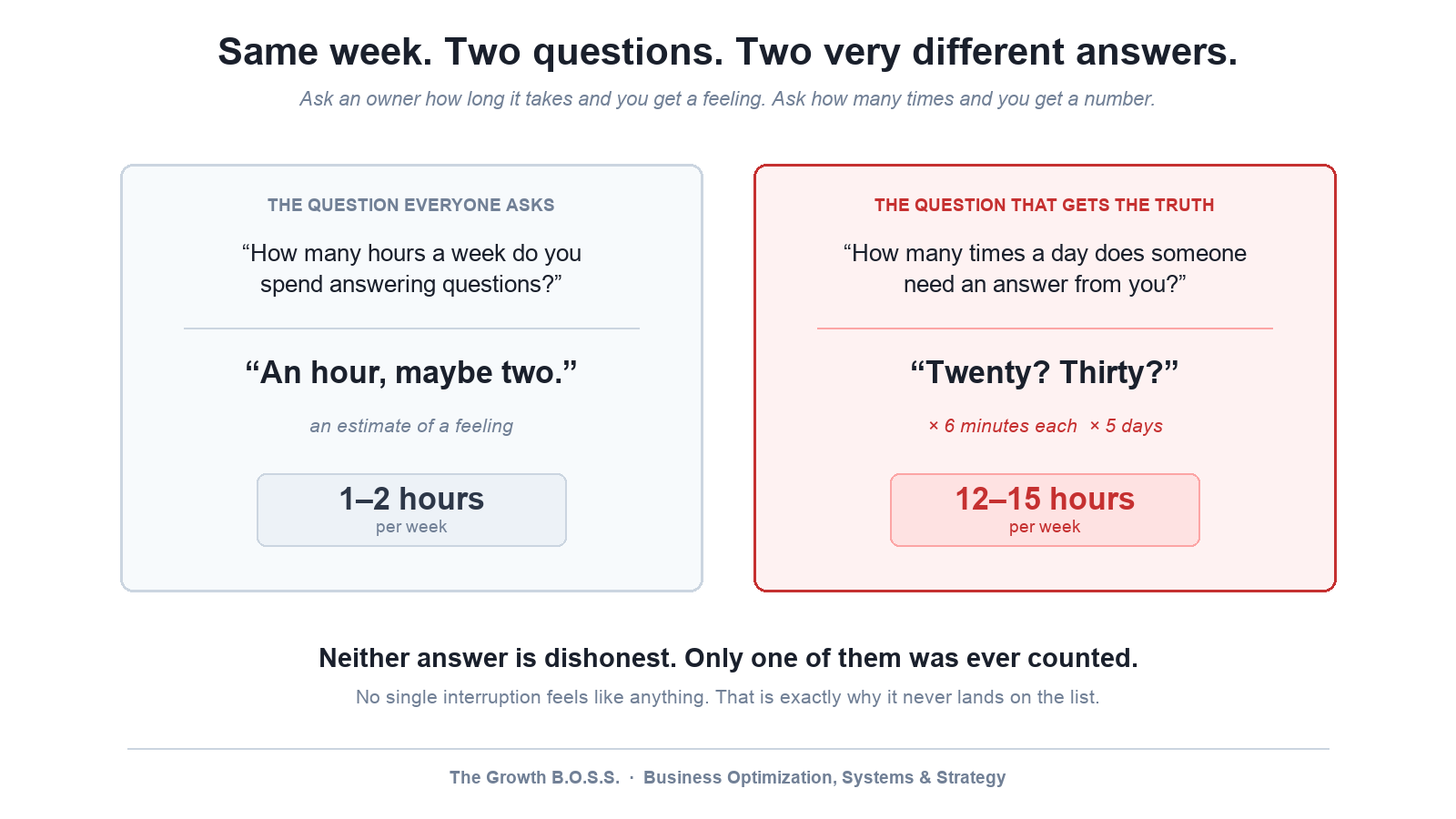
Neither answer is dishonest. The first is what it feels like, because no single interruption feels like anything. The second is what it is. The difference between them is the number that’s been running your business, and it has never once appeared on a list.
That multiplication gets done out loud, on the spot, every single time. It’s the most persuasive thirty seconds in the process, and it isn’t persuasive because of anything I said. It’s persuasive because you did the arithmetic yourself.
Two Objections
“I already know what I do all day.”
You know what you’re responsible for. That’s real knowledge and it’s not the same thing.
Here’s the test. Without looking at anything: how many times did someone interrupt you yesterday to get a decision before they could keep working? Not a feeling — a number. Almost nobody can produce one, and the people who guess are usually off by a factor of three.
That’s not a memory problem. It’s that the interruptions never got encoded as events, because each one was too small to notice.
“Isn’t this just time tracking with extra steps?”
It’s the opposite. Time tracking asks for precision you don’t need, over a period you won’t sustain, using a tool you’ll abandon by Wednesday.
This asks for a guess. And a guess is fine — Ben Slater, who’s built a good version of the spreadsheet approach, makes this point well: a well-thought estimate functions perfectly for this purpose. Nobody’s billing anyone. The goal is finding out which numbers are big. If an estimate is off by twenty percent, every decision that follows is still the same decision.
The whole thing is one conversation. Nothing to fill in, nothing to remember to do, nothing to abandon.
Why This Order Matters
There’s a structural reason to capture before you classify, and it isn’t just convenience.
Every classification system — including the good ones — asks you to make judgments about tasks. Is this high leverage? Does it give me energy? What department does it belong to? Those are reasonable questions, and they’re all easier to answer badly when the list in front of you is wrong.
If the biggest item in your week never made it onto the page, then every percentage calculated afterward is a percentage of the wrong denominator. You end up with a tidy pie chart of an incomplete week, and it feels like insight.
Get the week right first. Then decide.
What It Produces
At the end of this you have something nobody in the business has ever seen: an honest account of where your week actually goes, with numbers against it that you produced and believe.
Not a guess about the future. Not a job description. A record.
That record is what everything else runs on — because you can’t decide what should come off your plate until you can see what’s on it.
Start Here
You don’t need the full process to test whether any of this is true for you.
Tomorrow, keep a tally. Every time someone needs a decision from you before they can keep going — a text, a call, a walk-up, a “hey, quick question” — make a mark. Don’t fix any of them. Don’t shorten them. Just count.
At the end of the day, multiply the count by five minutes.
Most owners guess five to ten interruptions. The tally usually says twenty to thirty. The difference between those two numbers is the difference between “an hour of admin” and half your day — and it’s the reason the list you were about to write would have been wrong.
Next up: what to do with the list once you have it. There are only two questions that matter, and they have to be asked in the right order.