

Time you free up gets swallowed in about two weeks unless something has already claimed it. Decide where the hours go before the first one clears.
This is the seventh post in the Load Audit series. The first made the case that when a small business stalls, the narrowest point is usually your week. The second got an honest list of where that week goes. The third sorted every line into stop, move, or keep. The fourth put the moves in order. The fifth set the test for when a handoff is actually done. The sixth showed how to hand something off so it stays gone.
That last post ended on a promise: where the freed hours go, and why they disappear unless something has already claimed them.
This is that post.
Freed Time Doesn’t Stay Free
Say the handoff works. The job crosses the line. Your foreman does it twice, unprompted, to your standard. You get a few hours a week back.
Two weeks later, ask yourself where those hours went.
It’s usually hard to say. The hours didn’t go anywhere you’d point to. They got absorbed. A few more customer calls. A supplier problem you decided to handle yourself. A new idea that seemed worth an afternoon. Nothing on the list grew, and yet the week is just as full as it was before.
That’s the default. Freed time with nothing waiting for it gets reabsorbed in about two weeks. Not because you’re undisciplined. Because a busy business always has more small work than hours, and small work fills whatever space it’s given.
So the question isn’t whether the hours will get spent. They will. The question is whether you decide where, or the week decides for you.
Why It Happens
There are two reasons, and both will sound familiar.
Open time feels wrong. If you’ve run flat out for years, an empty hour doesn’t feel like a win. It feels like something you forgot.
A landscaping owner I worked with hit a week where, for the first time in a long time, there was nothing to chase. Here’s how he described it: “I kind of froze a little bit, like I don’t know what to do, because I am so used to being so busy going around everything. This last week has been a little bit like, am I doing something wrong?”
That’s the moment the hours are most at risk. When open time feels like a mistake, you fix it by finding something to do. And the closest thing to do is almost never the important thing.
The urgent thing is always closer. Whatever is ringing, broken, or late will beat the thing that would actually change the business. Every time. Not because it matters more, but because it’s louder.
A fence staining owner I worked with described being in the middle of exactly that. “I am so busy; I am like drinking out of a fire hose in a bad way,” he told me. “I am just not getting the big rocks done.”
Part of what was eating his week was a second business he’d started to keep his crews busy in the off-season. “It’s taking up all my time right now, and I haven’t been able to focus on the fence business, which is really the important one,” he said.
Nobody decided those hours should go to a new venture instead of the main one. They just went there, because nothing else had claimed them first.
Decide Before Anything Clears
The fix is timing. You decide where the hours go when you pick the handoffs, before a single one has cleared.
Not after. After is too late, because by the time you notice you have time back, it’s already been spent.
The commitment fits on three lines:
How many hours will cross the line this quarter.
By what date.
Where they go.
The first two come straight from the handoff queue you built in the fourth post. Add up the hours on the slice you’re working and pick a realistic date. The third is the one that matters, and it has a fixed order.
Where They Go, in Order
Stephen Covey had a picture for this in First Things First: a jar you fill with big rocks and then everything smaller. Put the small stuff in first and the rocks never fit. Put the rocks in first and the rest settles in around them.
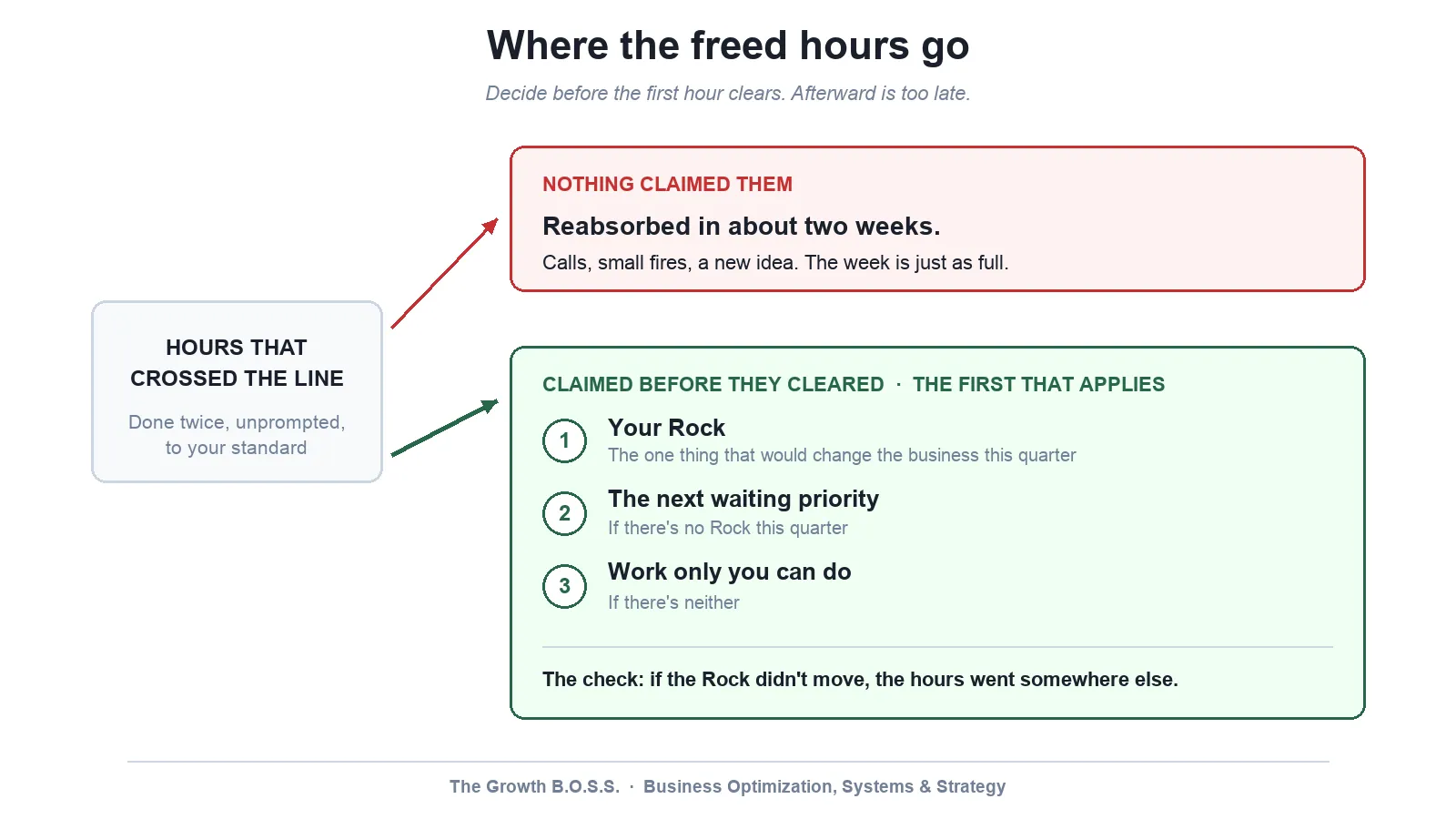
Your freed hours go to the first of these that applies.
1. Your Rock. The one thing this quarter that would actually change the business if it got done. A new service line priced correctly. A hire made properly. The sales process you’ve never written down. If you have a Rock, the hours go there. That’s the whole point of the audit. Small recurring work comes out of your week so the big thing fits.
2. The next priority that’s waiting for room. If you don’t have a Rock this quarter, look at your list of second-tier priorities. The projects you keep saying you’ll get to. The hours go to the top one.
3. The work only you can do. If neither of those exists, the hours go to something you kept for yourself because it needs you specifically. The work Dan Sullivan would call your Unique Ability. Selling the big jobs. The relationships that bring in referrals. The part of the business you’re there to do and aren’t doing enough of.
Whichever it is, name it. Specifically. “Growth” isn’t an answer. “More time for the business” isn’t either. If you can’t point at it, you can’t check it, and the hours will drift.
Say It Out Loud
Once you’ve named it, say the whole commitment in one sentence. To yourself, to a business partner, to your spouse, to whoever you answer to:
“This many hours come off my plate this quarter, by this date, and they go to this.”
Saying it out loud does the same thing it did for the handoff in the last post. It turns a private intention into a promise someone else heard. And it makes the next part possible.
The Check That Takes No Tracking
You don’t need a timesheet to know whether the hours went where you promised.
Look at the thing you named. If the Rock moved, the hours went there. If it didn’t move, the hours went somewhere else. It really is that simple.
That’s why naming something specific matters so much. A specific Rock either moved or it didn’t, and you’ll know at the end of the quarter without logging a single hour. A vague goal like “focus on growth” can’t fail, which means it can’t tell you anything either.
If the Rock didn’t move, don’t treat it as a character flaw. Treat it as information. Something claimed those hours first. Find out what, and that’s often the next thing that belongs on your list.
Two Objections
“I’ll figure out what to do with the time once I have it.”
That’s the plan almost everybody runs, and it’s the one that produces the frozen week and the fire hose. By the time you have the time, the small work has already found it. Deciding first costs you five minutes. Deciding later costs you the hours.
“I don’t have a Rock right now.”
Then the order handles it. The hours go to the next priority that’s waiting, or to the work only you can do. What they can’t go to is nothing in particular. That’s the one answer that guarantees they disappear.
Start Here
Take the handoff you’re working on right now, the one from the last post.
Write three lines:
Hours: how many hours a week come back when it crosses the line.
By when: the date you expect it to cross.
Where they go: your Rock, or the next waiting priority, or the work only you can do. One specific thing, by name.
Then say the sentence out loud to one person who will ask you about it later.
Next up: the lines on your list marked “nobody yet,” and how adding up those hours tells you when it’s time to hire.