

Most of what’s on your plate is real work. It just doesn’t all need to be yours. Two questions, asked in the right order, sort what stops, what moves, and the few things only you should keep.
This is the third post in the Load Audit series. The first made the case that when a small business stalls, the narrowest point usually isn’t leads or crew. It’s your week. The second showed how to see that week honestly: not by filling in a spreadsheet, but by walking through last week out loud, one ordinary day at a time.
If you did that, you now have a list. Thirty, forty, sometimes fifty lines of what actually fills your week.
This post is about what to do with it. Because most owners reach for the same next move: they start sorting it. Which of these can I delegate? Which ones should I hire for? Which ones am I good at, which ones do I hate, which ones are “on the business” instead of “in” it?
It feels like progress. It’s the step that quietly breaks the whole exercise.
Because some of what’s on that list doesn’t need to happen at all. Hand those off first and you haven’t freed anything. You’ve just moved waste onto a second person’s plate, and now you’re paying for it twice: once in their wages, and once in the time it takes to check on them.
There are only two questions that matter here. And the order is the whole point.
Question One: If This Didn’t Happen for 30 Days, What Breaks?
Go down the list once, one line at a time, and ask it about every task.
If this didn’t happen for the next 30 days — what breaks?
Notice what the question doesn’t ask. It doesn’t ask whether you could step away for 30 days. Most owners can’t picture that, and when pushed to, they defend the premise instead of looking at the task. This question keeps you out of the sentence. It’s only about whether the work earns its place.
Thirty days is deliberate, too. Mike Michalowicz uses it in Clockwork for a reason: it’s one full business cycle. Long enough that anything load-bearing visibly fails. Short enough to hold in your head.
There are four honest answers.
“Nothing, honestly.” That task stops. Not delegated. Stopped.
“Nothing right away, but it would catch up with us.” It stays on the list, marked degrades.
“That actually breaks.” It stays, marked breaks.
“That breaks, and revenue drops.” It stays, marked as the kind of work the business can’t breathe without.
Most of your list will land in degrades. That’s the answer nobody expects, and it’s the most useful one on the page. It means the work is real, but it doesn’t need to happen at its current size, or its current frequency, or with you doing it.
When Everything “Breaks”
For the first several lines, the answer will be “everything breaks.” That’s a reflex, not a verdict. So test it.
This doesn’t happen for a month. Who notices first — and on what day?
If you can name the person and the day, you’ve found something genuinely load-bearing. Good. You told yourself; nobody had to tell you.
If you can’t name them, it doesn’t break. It degrades.
One fence staining owner I worked with answered this question before anyone asked it. He’d been spending afternoons calling property management offices, and one day he just said it out loud: five hours of calls, and it doesn’t lead to anything. Meanwhile, the people who had actually asked for a quote were waiting on him.
Nothing broke when the calls stopped. The quotes went out faster.
Stops Are the Cheapest Hours You’ll Ever Get Back
Take the “nothing” answers aggressively.
A task you stop needs no one to receive it. No instructions, no training, no follow-up. It’s the only kind of change that gives you hours back the same week.
And it’s the only one with no real downside. If you’re wrong, you’ll know inside a month, and you can start it again.
Question Two: Who Else Could Do This?
Only the tasks that survived the first question get this one.
Who else could do this, if they were trained and you trusted them?
The answer has to be a name.
Not “a VA.” Not “someone in the office.” Not “we’d have to hire.” Every one of those means the same thing: I haven’t decided yet. And a plan built on an undecided answer is a delegation plan pointed at nobody.
This is Dan Sullivan and Ben Hardy’s point in Who Not How, made practical. The question isn’t how the task gets done. It’s who does it. A person, by name.
A system counts. If software, an automation, or an AI tool could take it, write that down as the receiver. A system is a name.
“Nobody yet” is also a real answer, and it gets its own pile. Keep that pile. We’ll come back to it.
“He Could, But He’d Do It Wrong”
That same fence staining owner, on handing off quotes: his lead guy might be able to do them, but he isn’t detail oriented.
That isn’t “nobody could.” That’s a name, with a problem attached.
The problem is real. It’s also a documentation problem, not a reason for the work to stay yours. Write the name down. What the person needs before the handoff — a written standard, one watched run, a clear rule for when it comes back to you — is a separate step, and it’s where that nervousness actually gets answered.
The Keep Check
Some tasks will get “nobody could.” Every one of those gets a follow-up, asked right then:
Is that because it needs judgment nobody else has, because nobody’s been shown how, or because this is the work you’re here to do?
Judgment is real. Pricing a job nobody’s priced before. Letting someone go. Deciding what the business does next year. Those stay.
The work you’re here to do is real, too. It’s the reason the business exists with you in it, and it stays.
Nobody’s been shown is not a keep. It’s a training gap wearing a keep’s clothes.
The tell is one sentence: “Because I’m the only one who does it right.” That’s skill, not judgment. And skill transfers.
The same owner who wanted “the last eyes” on every quote also said, in the same conversation, that he’d hand off residential quotes before commercial ones. That’s the keep check running itself. Residential quotes were a skill. The big commercial bids were a judgment call. Same task name on the list. Two different answers.
Three Outcomes, Fewer Than Five Keeps
Every line on your list ends up in one of three places.
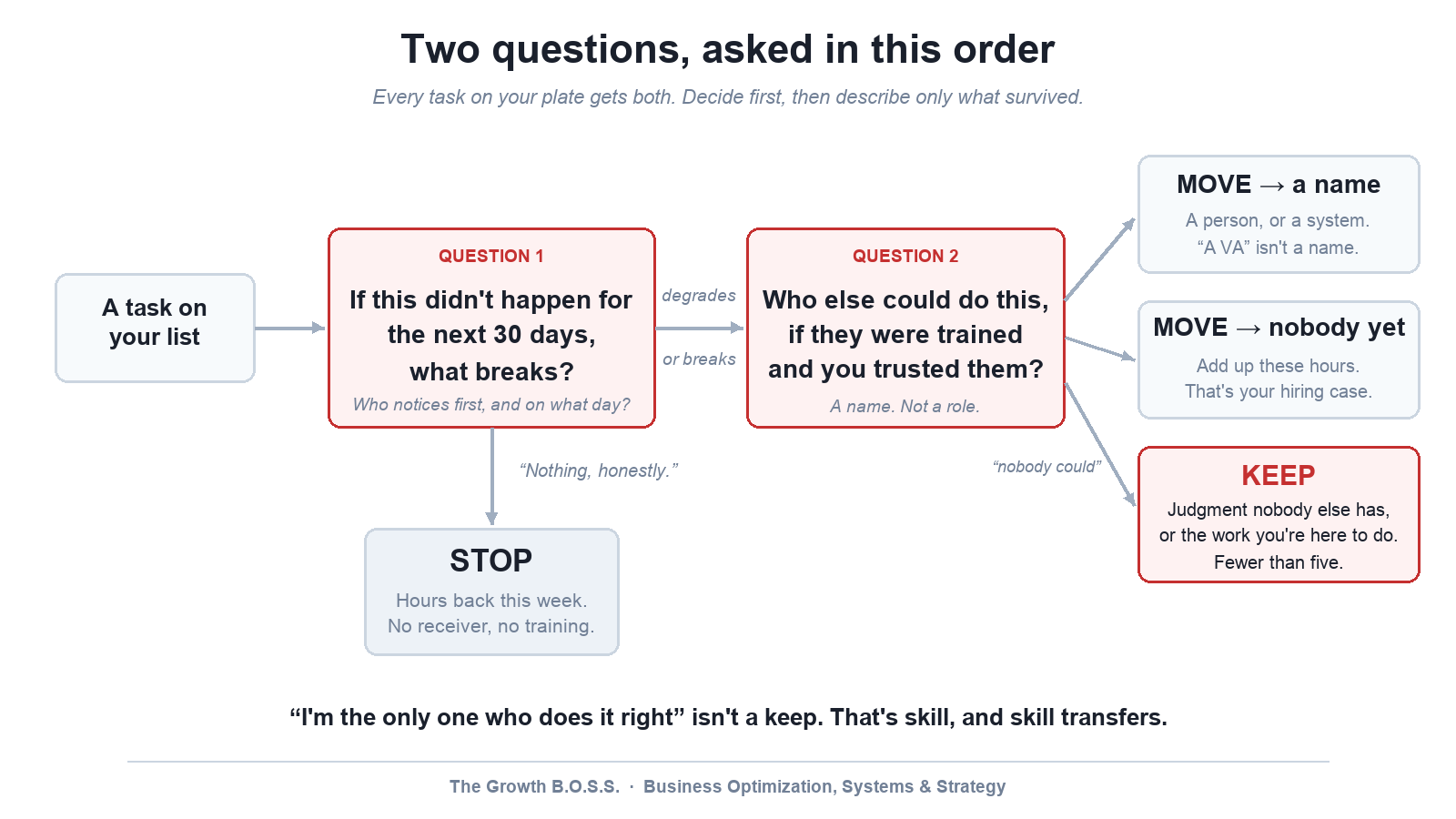
Stop. It doesn’t need to happen. It’s gone.
Move. It needs to happen, and it has a named receiver — a person, a system, or “nobody yet.”
Keep. It needs judgment only you have, or it’s the work you’re here to do.
In most businesses, there should be fewer than five keeps.
If you end up with twelve, you don’t have twelve judgment calls. You have a trust problem. That’s a real problem and it’s worth working on, but it’s a different conversation than this one. No sorting system fixes it.
Why the Order Can’t Flip
Ask “who could do this?” first and you’ll delegate work that should have been stopped. Now someone else is doing the thing nobody needed, and it’s harder to kill because it has an owner who wants to keep their job.
Ask “is this high-value or low-value?” first — or any of the classification questions — and you’ll spend an afternoon scoring tasks that were about to disappear. That’s how the spreadsheet in the last post died at line twenty.
Decide first. Then describe only what survived.
The Number That Falls Out
Remember the “nobody yet” pile?
Add up the hours on it. Out loud.
That total changes the conversation about hiring. Not “I think I need someone.” Instead: “There are fourteen hours a week already waiting for them.”
And it came from your own list, one line at a time. Nobody told you to hire. The arithmetic did.
That’s also why this has to run before any hiring conversation, not after one. Hire first and the new person lands on whatever you happened to hand them. Run the two questions first and you know exactly which hours they’re walking into.
Two Objections
“If I don’t do it, it won’t get done right.”
Sometimes true — today. The question isn’t whether someone can do it right now. It’s whether someone could, if they were trained and you trusted them. Those are two different questions, and only one of them is about the future.
If the honest answer is “yes, if I showed them,” the work isn’t a keep. It’s a handoff that hasn’t been built yet.
“I can’t afford to hire anyone.”
Then don’t. Nothing in either question requires a hire.
Stops need no one. Moves to a system need no one. Moves to people already on the payroll need no new payroll. The “nobody yet” pile is the only part that points at a hire, and it points with a number attached, so you can decide when it’s worth it instead of guessing.
Start Here
Take the five biggest lines from your week. If you did the tally from the last post, the interruption count is probably one of them.
Ask the first question about each. If it didn’t happen for 30 days, who notices first, and on what day?
Don’t move to the second question yet. Just mark each one: stops, degrades, or breaks.
Most owners find at least one stop in their top five. That’s hours back this week, with no hire, no training, and nobody to check on.
Next up: once you have a pile of moves, which one goes first. It’s almost never the biggest one — and getting that order wrong is the most common reason delegation fails the first time.