

A task is off your plate when someone else has done it twice, unprompted, to your standard. Until then, it’s still your load.
This is the fifth post in the Load Audit series. The first made the case that when a small business stalls, the narrowest point is usually your week. The second got an honest list of where that week goes. The third sorted every line into stop, move, or keep. The fourth put the moves in order and picked the first handoff.
So you’ve handed something off. Good.
Now the question nobody asks: how do you know it’s gone?
Handed Off Isn’t the Same as Gone
Most delegation advice stops at the handoff. You explain the job, the other person says “got it,” and the task comes off your list.
Then, a few weeks later, you notice you’re doing it again.
Not all of it. Just the parts that matter. You check every one before it goes out. You fix the small things yourself because it’s faster than explaining. You ask “did you get to that?” on Thursday, just to be sure. Nobody decided it should come back. It drifted back, one quiet rescue at a time.
And your list still says it’s delegated.
That’s the gap this post is about. On paper, the task moved. In your week, it didn’t. And because the list says it’s handled, nobody goes looking for the hours that never actually left.
The Clear Line
Here’s the test. It’s one sentence:
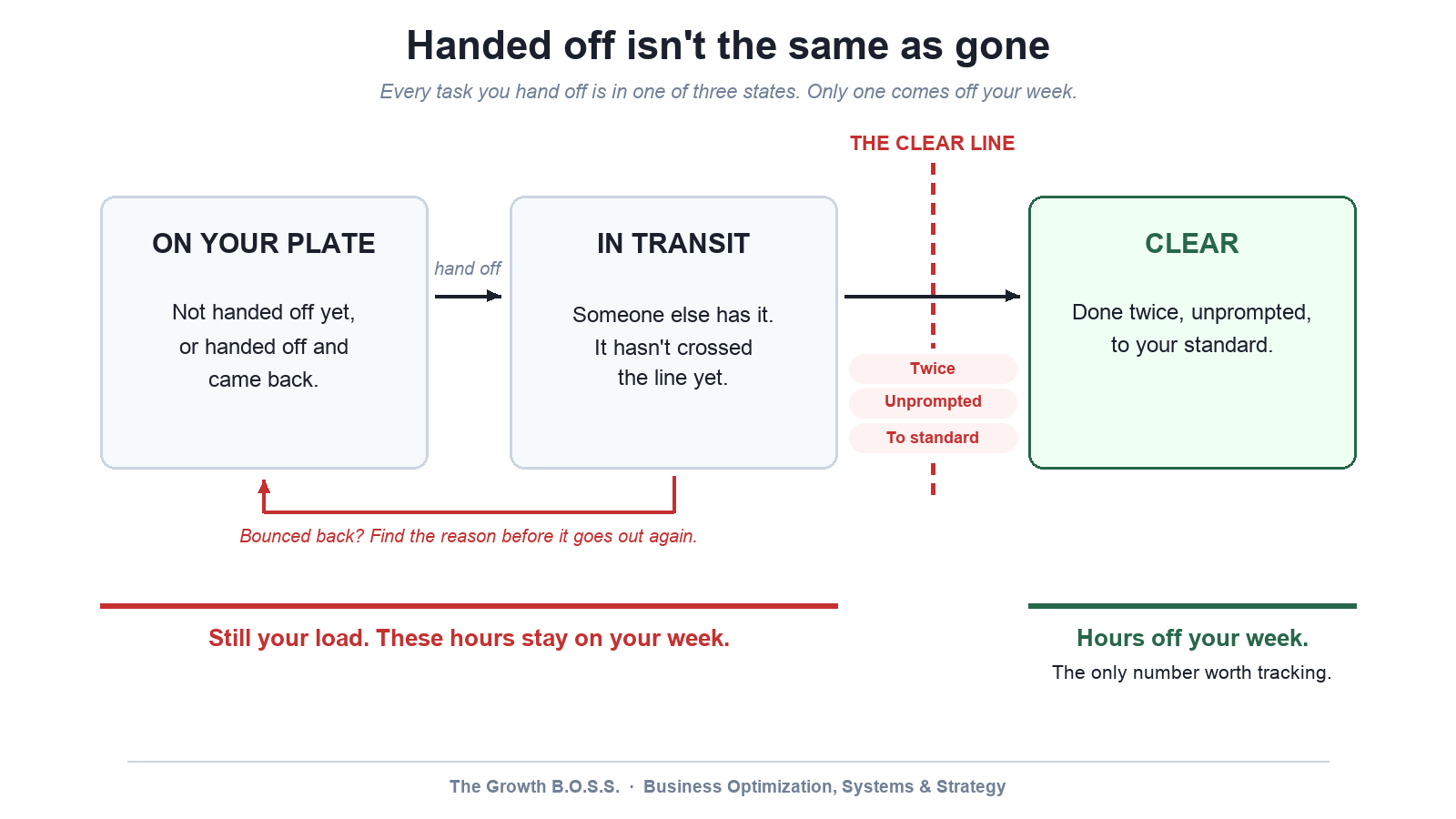
A task is off your plate when the other person has done it twice, unprompted, to your standard.
All three parts are required.
Twice. Once can be the run you watched. Once can be luck. Two times in a row is a pattern.
Unprompted. Nobody reminded them. If you had to ask “did you do the…?”, it’s still on your plate. The reminder is the load. You’ve traded doing the task for remembering it, and remembering it still takes up room in your head.
To your standard. The standard you set when you handed it off, in your own words. Not “close enough.” Not “they did it, but I had to fix it.” If you’re fixing it, you’re still doing it.
Until all three are true, the task hasn’t crossed the line. It’s in transit.
Three States, and Only One Counts
Every task you hand off is in exactly one of three states.
On your plate. You haven’t handed it off yet, or you did and it came back.
In transit. Someone else has it, but it hasn’t crossed the line yet.
Clear. Done twice, unprompted, to your standard.
None of this is a verdict on the person taking it on. In transit is a normal place for a task to sit for a few weeks while someone learns it. The point is just to call it what it is.
The rule that makes this useful: in transit still counts as yours. The hours don’t come off your week until the task is clear. Not when you announce the handoff. Not when you write the instructions. When it crosses.
That sounds strict. It’s meant to be. It’s the only way your list stays honest about where your time actually goes, instead of showing progress that didn’t happen.
What It Looks Like When Nobody Checks
A landscaping company owner I worked with had a handful of new systems built over the course of a year. Some took work off his plate without asking anything of him. An AI receptionist started booking appointments. Two people on his team got the authority to send invoices, so payment no longer waited on him.
Those stuck. They didn’t need him to change a single habit.
The others needed him to work differently. A shared task board. Timesheets and job costing. A daily huddle. One by one, those slid back to the old way. And the record still said every one of them had been delivered.
The clearest sign showed up near the end. The team built its own spreadsheet that copied the task board, line for line, because the board wasn’t being kept up and they still needed to know what was going on.
Nobody did anything wrong on purpose. The systems were built. The handoffs happened. What was missing was a test that said, in plain terms, whether each one had actually landed. Without it, “delivered” and “done” looked exactly the same on paper, right up until the team started working around them.
That’s what in transit looks like when nobody’s measuring it. The work had been “handed off.” It just never crossed.
When a Task Comes Back
Some handoffs will bounce. That’s normal. What matters is what you do next.
When a task comes back to you, it goes back to on your plate, and you find out why before you hand it off again. It’s almost always one of four reasons:
The standard wasn’t specific enough to check. “Handle customer questions well” can’t be checked. “Same-day reply, and if we don’t know the answer yet, tell them when they’ll have it” can.
The other person didn’t know what was theirs. Nobody said which situations still come to you, so they brought you everything.
They never actually had the access. The login, the card, the authority to say yes. Without it, the job comes back to the one person who has it.
You handed it off and kept doing it anyway.
The first three you can fix in an afternoon. The fourth one is harder, because the fix isn’t in the process. It’s in you. Usually it’s the step you still want to be the last eyes on.
One more rule. A task that bounces twice doesn’t go out a third time the same way. If it failed the same way twice, change the approach, not the number of attempts.
The Number Worth Tracking
Most owners who delegate keep score by counting tasks. “I handed off six things this quarter.”
That number is easy to make look good. Hand off six things, take four of them back, and the count still says six.
Track this instead: hours that crossed the line. Take every task that’s clear, add up the hours a week it used to cost you, and that’s the number.
It’s the only figure that can’t be gamed. A task that’s in transit doesn’t count. A task you’re still checking doesn’t count. A task that drifted back definitely doesn’t count. If the number goes up, your week actually got lighter. If it doesn’t, no amount of activity changes that.
Two Objections
“Twice is a lot to ask before I trust it.”
It’s less than you’re asking now. Most owners never set a test at all, so the task stays in limbo for months: not quite theirs, not quite gone. Two clean runs is a short, clear finish line. And it gives the other person something specific to hit, which is a lot easier than guessing when you’ll finally stop checking.
“If I don’t check, how will I know it’s done right?”
You’ll check. Just on purpose, at a set time, against the standard you agreed on, instead of hovering over every one. Checking on a schedule is part of a good handoff. Checking everything, every time, is the task coming back.
Start Here
Look at the handoff you picked from the last post, or anything you’ve handed off in the past few months.
For each one, ask three questions. Has the other person done it at least twice? Did they do it without you asking? Did it meet the standard without you fixing it?
Three yeses: it’s clear. Write down the hours it used to take you. That’s your first number.
Anything less: it’s in transit. Leave those hours on your plate for now, and pick which of the four reasons is holding it up.
Next up: how to hand something off so it actually stays gone.