
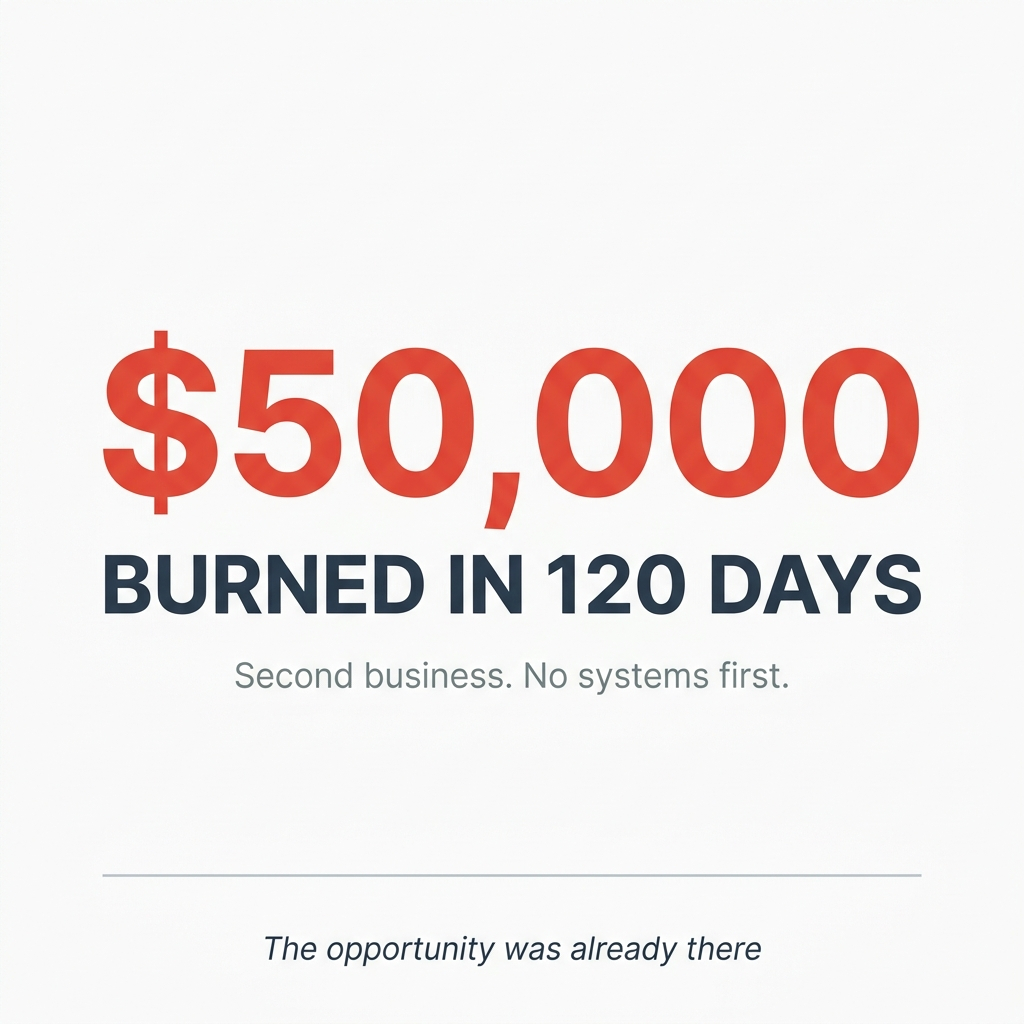
I watched a business owner light tens of thousands of dollars on fire in four months.
He didn’t mean to. He thought he was being smart. He saw a problem in his fencing business—winter downtime—and decided to solve it by launching an epoxy flooring company.
No market research. No competitor analysis. No calculation of customer acquisition costs.
Just a weekend workshop in Vegas, some new equipment, and the belief that he could train crews to run a second business while he still handled every estimate in his $600,000 fencing operation.
Four months later, he shut it down.
The flooring business wasn’t profitable. Prices were too low. Competition was too fierce. Customer acquisition costs were too high. And the whole time he was trying to make it work, he ignored the real opportunity sitting right in front of him.
This isn’t a story about bad luck. It’s about a pattern I see constantly with business owners at the 6-7 figure level.
You hit a ceiling. Revenue plateaus. You’re working 50-60 hours a week. And instead of fixing what’s broken in your current business, you convince yourself that starting something new will solve the problem.
It won’t.
The Illusion of Diversification
Most entrepreneurs think launching a second business reduces risk.
Multiple income streams. Different revenue sources. Protection against seasonal slowdowns.
It sounds logical. But when you launch a non-adjacent business before you have systems in place, you’re not diversifying risk—you’re multiplying failure points.
The fencing company owner thought epoxy flooring would keep his crews busy year-round. What he didn’t realize was that he’d become the bottleneck in both businesses.
He was still the only person doing estimates. He had no documented processes. No one on his team could make decisions without him. And now he was trying to learn an entirely new market while managing daily operations in his primary business.
You can’t delegate what you haven’t systematized.
When I started working with him, we identified his constraint immediately. He’d completed roughly 200 residential fencing jobs and 10 HOA jobs the previous year. The HOA contracts brought in close to 80% of his revenue.
Ten clients. Eighty percent of revenue.
That’s Pareto’s Principle in action. But instead of doubling down on HOA work and training someone to handle residential estimates, he was chasing a completely different market he knew nothing about.
What Market Analysis Actually Means
When I ask business owners if they’ve done market research before launching something new, most say yes.
Then I ask what that research included.
The answers are usually vague. They talked to a friend. They saw someone else doing it. They went to a workshop.
That’s not market analysis. That’s hope.
Real market research doesn’t require an MBA or a consulting firm. It requires a few phone calls and some basic math.
Here’s what you need to know before you launch anything new:
1. What are competitors charging?
Call around. Pretend you’re a customer. Get quotes. If you can’t match or beat their pricing while maintaining healthy margins, you’re starting at a disadvantage.
2. What are your actual costs?
Calculate cost of goods sold. Factor in labor. Don’t forget overhead. Most business owners underestimate this by 30-40%.
3. How much does it cost to acquire a customer?
If you’re relying on paid ads, talk to the companies that specialize in your market. Ask what they charge per lead and what conversion rates look like. Do the math before you spend a dime.
The fencing company owner skipped all three steps.
He assumed he could charge competitive rates. He didn’t calculate his true costs until he was already losing money. And he had no idea what customer acquisition would cost until he was deep into ad spend.
By the time he realized the business wasn’t viable, he’d already invested tens of thousands of dollars and four months of attention that should have been focused on his fencing operation.
Fighting Two Fronts Without Supply Lines
I spent 25 years in the military. One of the most basic principles of warfare is this: don’t fight on two fronts without the supply lines to support both.
When you try to run two unrelated businesses without systems, you’re doing exactly that.
In the epoxy flooring market, the fencing company owner was fighting two fronts simultaneously. Prices were being driven down by low barriers to entry—anyone could take a weekend workshop and start a flooring business. At the same time, customer acquisition costs were being driven up because everyone was competing for the same leads through paid advertising.
Lower prices. Higher acquisition costs. No differentiation.
That’s not a business. That’s a math problem that doesn’t solve.
Meanwhile, back in his fencing business, opportunities were slipping away. He couldn’t train anyone to do estimates because he was too busy learning epoxy techniques. He couldn’t pursue new HOA contracts because his days were filled with sand—small, urgent tasks that felt important but didn’t move the needle.
Our coaching sessions, which he was paying for to grow his fencing business, turned into troubleshooting sessions for a failing flooring venture.
That’s the hidden cost nobody talks about.
It’s not just the money you lose on the new business. It’s the opportunity cost in your existing business. The momentum you don’t build. The systems you don’t create. The revenue you leave on the table.
The Question That Stops People in Their Tracks
When someone comes to me excited about a second business idea, I ask one question:
“What makes you different than the competitors?”
If they can’t answer that clearly and specifically, they’re not ready.
Most people give generic answers. “Better service.” “Higher quality.” “More attention to detail.”
Those aren’t differentiators. Those are table stakes.
When you enter a new market, you start with zero recognition, zero customer base, and zero trust. If you can’t articulate what makes you stand out, you’re asking customers to choose you for no reason.
The fencing company owner couldn’t answer this question for the epoxy business. He had no established reputation. No unique process. No reason for customers to choose him over the dozens of other flooring companies in his area.
But here’s what’s interesting: he couldn’t answer it for his fencing business either.
That’s the real problem. When you can’t differentiate your existing business, launching a new one won’t solve it. You’re just spreading the same problem across two companies.
The Untapped Potential You’re Sitting On
Every time I work with a business owner who wants to start something new, we do the same exercise.
We look at their current business and ask: What would make our customers say “wow”?
Not “that’s nice.” Not “good job.” Wow.
For the fencing company, the answer was obvious. Faster response times on estimates. Proactive project updates. A dedicated point of contact for HOA boards. Better communication with homeowners during installation.
None of that required a new business. It required better systems in the existing one.
When you improve the customer experience in your current business, three things happen:
1. You charge more.
Customers pay premium prices for premium experiences. When you’re the only fencing company that responds to estimates within 24 hours and provides weekly project updates, you’re not competing on price anymore.
2. You get more referrals.
People don’t refer “good” companies. They refer companies that exceeded expectations. When you create wow moments, your customers become your sales team.
3. You build a moat.
Competitors can copy your pricing. They can’t easily copy a well-oiled system that consistently delivers exceptional experiences.
The fencing company owner had 10 HOA clients generating 80% of his revenue. Imagine if he’d spent those four months building systems to serve those clients better and win more contracts like them.
He could have trained someone to handle residential estimates. He could have documented his sales process. He could have created templates for HOA proposals. He could have built relationships with property management companies.
Instead, he learned how to apply epoxy flooring.
When Expansion Actually Makes Sense
I’m not saying you should never start a second business. I’m saying you need to earn the right to do it.
You’re ready to expand when:
Your existing business runs without you in daily operations.
If you’re still the person doing estimates, handling customer service issues, or making every decision, you’re not ready. Your business needs to function smoothly when you step away for a week.
You have documented systems for everything that matters.
Sales process. Client onboarding. Service delivery. Quality control. If it’s all in your head, it can’t scale.
Your team can solve problems without you.
This doesn’t mean they never ask questions. It means they can handle 80% of situations independently using the systems you’ve built.
You’ve maximized the opportunity in your current market.
Not “tapped out.” Maximized. There’s a difference. You’ve built the systems, hired the team, and created the processes to capture as much market share as your systems can handle.
The new business is adjacent or complementary.
You can leverage existing relationships, expertise, or infrastructure. You’re not starting from zero in every dimension.
The fencing company owner met none of these criteria. And that’s why the expansion failed.
From Hustle Culture to Systems Culture
There’s a narrative in entrepreneurship that celebrates doing more. More businesses. More revenue streams. More hustle.
It’s exhausting. And it’s wrong.
The most successful business owners I know aren’t the ones running five companies. They’re the ones who built one company so well that it funds everything else they want to do.
They’re not working 80-hour weeks. They’re working 30-hour weeks because they built systems that work without them.
They’re not chasing every opportunity. They’re saying no to opportunities that don’t align with their strengths and existing infrastructure.
Entrepreneurial maturity isn’t about how many businesses you can start. It’s about knowing when not to start one.
The fencing company owner is back to focusing on his core business now. The epoxy equipment is sitting in storage. The vehicle wrap was nice but expensive. The marketing spend is gone.
But he learned something valuable: the opportunity he was chasing was already in his business. He just couldn’t see it because he was too busy looking elsewhere.
What to Do Instead
If you’re thinking about starting a second business, stop.
Not forever. Just for now.
Do this first:
Identify your constraint.
What’s the one thing holding your current business back from growing? Is it lead generation? Sales capacity? Fulfillment? Your own time?
Document one system per month.
Pick the most painful process in your business. Write it down. Record a Loom video. Create a checklist. Make it repeatable.
Train someone to own it.
Don’t just delegate tasks. Delegate ownership. Give someone the responsibility and authority to run that process without you.
Analyze your Pareto.
Which 20% of your customers drive 80% of your revenue? How can you get more of them? What would make them say wow?
Do basic market research on your current business.
Call your competitors. See what they’re charging. Ask your customers why they chose you. Find out what you’re known for.
If you do these five things, one of two outcomes will happen.
Either you’ll realize your current business has way more potential than you thought, and you’ll stop thinking about expansion.
Or you’ll build the systems and team that actually make expansion possible.
Either way, you win.
The Real Cost of the Wrong Timing
The fencing company owner didn’t just lose money on the epoxy business. He lost time he can’t get back.
The season is starting now. He still doesn’t have anyone trained to do residential estimates. He missed the momentum he could have built during the off-season. He’s starting from the same place he was a year ago, minus tens of thousands of dollars and four months of focus.
That’s what premature expansion costs you.
Not just the money you spend on the new venture. The progress you don’t make in your existing business. The systems you don’t build. The team you don’t develop. The customers you don’t wow.
You can’t get that time back.
But you can make a different choice right now.
You can choose to build the foundation before you build the second floor. You can choose to systemize before you expand. You can choose to become really, really good at one thing before you try to be mediocre at two things.
Your business doesn’t need another revenue stream. It needs systems that let the current stream flow without you standing in it.
Build those first.
Everything else can wait.
Ready to Build the Foundation?
If you’re a 6-7 figure business owner who’s been thinking about expansion but knows deep down that your current business isn’t ready, let’s talk.
I’m offering 90 days of hands-on consulting to three business owners who want to stop chasing new opportunities and start maximizing the one they already have.
We’ll identify your constraint. Document your most critical systems. Train your team to own processes without you. And create a roadmap that turns your good company into a great one.
No fluff. No theory. Just practical implementation that frees up your time and increases your revenue.
Book a free discovery call and let’s see if this is a fit.
Click here to schedule: https://calendly.com/clay-westerlund/growth-boss-consultation-call
Let’s make sure your next move is the right one.